Decoherence
Decoherence degrades pure quantum states into classical mixtures, quantified by T1 relaxation and T2 dephasing times
Source: mortalapps.com- Decoherence is the loss of quantum behavior due to environmental coupling, transitioning a pure state into a classical mixed state.
- The density matrix diagonal elements represent populations, while off-diagonal elements represent quantum coherences.
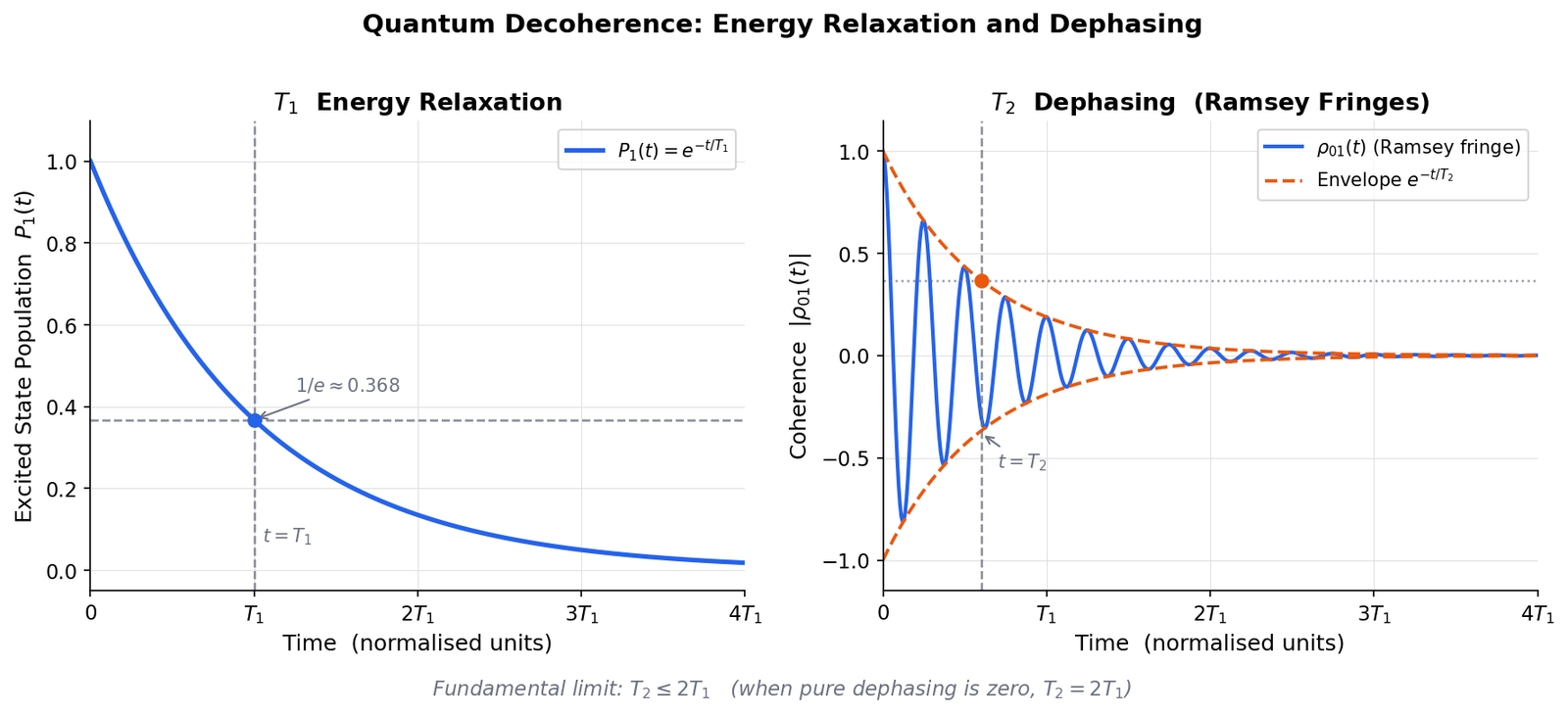
- T1 (longitudinal relaxation) measures the characteristic time for a qubit to lose energy and decay to the ground state.
- T2 (transverse relaxation) measures the characteristic time for a qubit to lose its relative phase relationship.
- The fundamental limit of coherence is $T_2 \le 2T_1$, meaning dephasing is always bounded by energy relaxation.
- Different hardware platforms have vastly different coherence times, ranging from microseconds (superconducting) to seconds (trapped ions).
Why This Matters
Decoherence is the process by which a quantum system loses its quantum properties, such as superposition and entanglement, due to interactions with its surrounding environment. It represents the transition from the quantum regime to classical reality. In this topic, we will explore the physical mechanisms of decoherence, define the critical hardware parameters $T_1$ (energy relaxation) and $T_2$ (dephasing), and analyze how they limit the performance of physical quantum computers.
Core Intuition
To understand decoherence, imagine a synchronized group of swimmers performing a routine in a pool. At the start, they are perfectly in phase, moving together in harmony (representing a coherent superposition state). Now, imagine a wave machine is turned on, creating random ripples in the pool (representing environmental noise). As the ripples hit the swimmers, they get pushed slightly out of sync. Soon, their movements are completely uncorrelated, and the collective pattern is lost. This loss of phase synchronization is called dephasing ($T_2$).
Now, imagine one of the swimmers jumps out of the pool to rest on the deck. This represents energy relaxation ($T_1$), where a qubit in the high-energy excited state $|1\rangle$ loses its energy to the environment and drops back down to the ground state $|0\rangle$. Once the swimmer is on the deck, they can no longer participate in the routine. Both processes, losing phase synchronization and losing energy, destroy the quantum information stored in the system, turning a clean quantum superposition into a boring, classical mixture.
Visualization
Technical Explanation
Decoherence is mathematically described using the density matrix formalism. A pure single-qubit state $|\psi\rangle = a|0\rangle + b|1\rangle$ has the density matrix: $$\rho = |\psi\rangle\langle\psi| = \begin{pmatrix} |a|^2 & a b^* \\ a^* b & |b|^2 \end{pmatrix}$$ where the diagonal elements represent the populations of the states, and the off-diagonal elements represent the quantum coherences (the phase relationship between $|0\rangle$ and $|1\rangle$).
Decoherence manifests as two distinct physical processes: 1. Energy Relaxation ($T_1$): Also known as longitudinal relaxation, this is the process by which a qubit in the excited state $|1\rangle$ decays to the ground state $|0\rangle$ by emitting energy into the environment. The population of the excited state decays exponentially over time: $$P_1(t) = e^{-t/T_1}$$ 2. Dephasing ($T_2$): Also known as transverse relaxation, this is the process by which the relative phase between $|0\rangle$ and $|1\rangle$ is randomized without any energy exchange. The off-diagonal elements of the density matrix decay exponentially: $$\rho_{01}(t) = \rho_{01}(0) e^{-t/T_2}$$
The total dephasing rate $1/T_2$ is bounded by the energy relaxation rate $1/T_1$ and the pure dephasing rate $1/T_{\phi}$: $$\frac{1}{T_2} = \frac{1}{2T_1} + \frac{1}{T_{\phi}}$$ This fundamental relation implies that $T_2$ can never be greater than $2T_1$. If pure dephasing is completely eliminated ($T_{\phi} \to \infty$), the coherence time reaches its theoretical limit, $T_2 = 2T_1$, known as the relaxation-limited lifetime.