Noise Simulation
Noise models built from calibration data simulate gate errors, readout errors, and decoherence on a classical computer
Source: mortalapps.com- Physical quantum computers in the NISQ era are highly susceptible to environmental noise, which degrades execution results.
- Noise simulation models physical imperfections, such as gate errors, readout errors, and decoherence, on classical computers.
- Mathematically, noise is modeled using density matrices and quantum channels (Kraus operators) rather than pure statevectors.
- Qiskit Aer allows you to automatically generate realistic noise models using calibration data from real IBM Quantum backends.
- Fake backends (like
FakeSherbrooke) are local simulators pre-configured with the physical parameters of real processors. - Decoherence ($T_1$ and $T_2$ times) limits the lifetime of qubits, requiring programmers to minimize circuit depth.
Why This Matters
In the current Noisy Intermediate-Scale Quantum (NISQ) era, physical quantum computers are highly sensitive to environmental interference. Unlike classical transistors, which can operate for years without a single bit-flip error, physical qubits decohere and lose their quantum information in a fraction of a millisecond. Consequently, running a quantum program on real hardware yields results that are degraded by noise.
To develop algorithms that are robust to these errors, we must be able to simulate noise. A noise simulator is a classical program that models the physical imperfections of a specific quantum processor, such as gate errors, readout errors, and thermal relaxation. By simulating noise locally, we can predict how our algorithms will perform on real hardware without consuming valuable cloud execution time.
In this topic, you will explore the mechanics of noise simulation in Qiskit. You will learn about the primary sources of quantum noise, understand how Qiskit represents noise mathematically, and write code to build noise models from real hardware calibration data. You will run simulations using AerSimulator and a fake backend, and analyze how noise degrades the perfect correlations of an entangled state.
Core Intuition
Think of an ideal quantum simulator like a pristine, indoor physics laboratory. In this lab, there is no air resistance, no friction, and no temperature fluctuations. Every experiment behaves exactly according to the textbook equations. This is a great place to learn the basic laws of physics.
However, if you are designing a commercial drone, you cannot test it only in a pristine lab. You must test how it behaves in the real world, where there are gusty winds, rain, and dust. A noise simulator is like a wind tunnel. It takes the pristine physics model of your drone and injects simulated wind and turbulence (noise) to see if it can still fly.
In quantum programming, a noise model takes your perfect circuit and injects simulated errors. A gate error is like a gust of wind that slightly tilts the drone; a readout error is like a faulty camera sensor that misidentifies the drone's position; and decoherence is like the battery slowly draining. By simulating these 'weather conditions' locally, you can optimize your circuit design to withstand the harsh realities of physical hardware.
Visualization
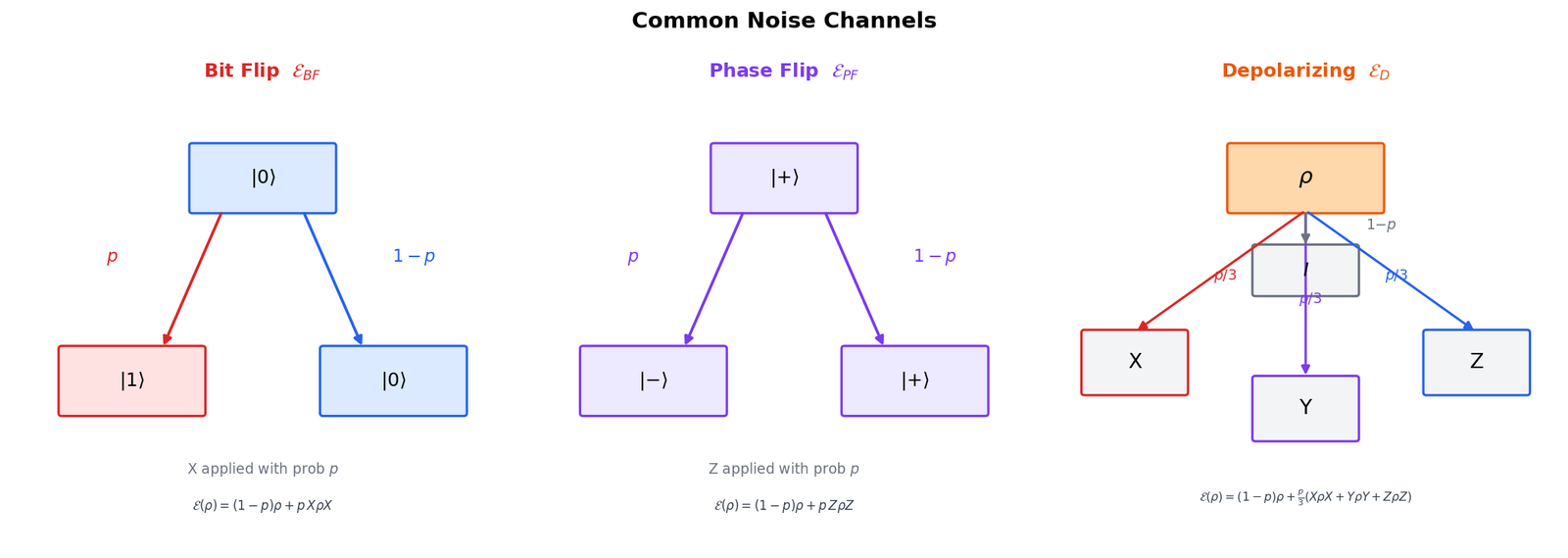
Technical Explanation
Mathematically, noise transforms a pure quantum state $\lvert \psi \rangle$ into a mixed state, represented by a density matrix $\rho = \lvert \psi \rangle \langle \psi \rvert$. A noise process (or quantum channel) is represented by a set of Kraus operators $\{E_k\}$ acting on the density matrix:
$$\mathcal{E}(\rho) = \sum_k E_k \rho E_k^\dagger$$
Subject to the completeness relation $\sum_k E_k^\dagger E_k = I$. For example, a single-qubit depolarizing channel, which models a gate error that completely randomizes the state with probability $p$, is represented by:
$$\mathcal{E}(\rho) = (1 - p)\rho + \frac{p}{3}(X\rho X + Y\rho Y + Z\rho Z)$$
Qiskit Aer allows us to construct complex NoiseModel objects that combine these mathematical channels. Instead of building these models from scratch, we can automatically generate a realistic noise model by importing the calibration data of a real IBM Quantum processor using a 'fake backend' (a high-fidelity simulator pre-configured with a specific chip's physical parameters).
Here is a complete Qiskit 1.x program that builds a noise model from a real 127-qubit processor (ibm_sherbrooke) and simulates its impact on a Bell state:
from qiskit import QuantumCircuit
from qiskit_aer import AerSimulator
from qiskit_aer.noise import NoiseModel
from qiskit_ibm_runtime.fake_provider import FakeSherbrooke

# 1. Build the circuit with measurements
qc = QuantumCircuit(2)
qc.h(0)
qc.cx(0, 1)
qc.measure_all()

# 2. Load a fake backend representing a real physical processor
# FakeSherbrooke mimics the 127-qubit 'ibm_sherbrooke' system
fake_backend = FakeSherbrooke()

# 3. Extract the noise model from the fake backend
noise_model = NoiseModel.from_backend(fake_backend)

# 4. Instantiate the AerSimulator with the noise model
# We also pass the coupling map to simulate physical qubit connectivity
simulator_noisy = AerSimulator(
    noise_model=noise_model,
    coupling_map=fake_backend.coupling_map,
    basis_gates=fake_backend.operation_names
)

# 5. Run the noisy simulation
shots = 1024
job_noisy = simulator_noisy.run(qc, shots=shots)
result_noisy = job_noisy.result()
counts_noisy = result_noisy.get_counts()

# 6. Run an ideal, noiseless simulation for comparison
simulator_ideal = AerSimulator()
job_ideal = simulator_ideal.run(qc, shots=shots)
result_ideal = job_ideal.result()
counts_ideal = result_ideal.get_counts()

print("Ideal (Noiseless) Counts:", counts_ideal)
print("Noisy (Realistic) Counts:", counts_noisy)
In this code, the ideal simulation yields counts only for '00' and '11'. The noisy simulation, however, will contain 'error counts' for '01' and '10' (typically 1% to 5% of the total shots), demonstrating how physical noise degrades the perfect correlation of the Bell state.
Key Takeaways
FakeSherbrooke) are local simulators pre-configured with the physical parameters of real processors.