State Evolution
Between measurements, a qubit evolves continuously and deterministically under the Schrodinger equation unitarily
Source: mortalapps.com- Closed quantum systems evolve continuously and deterministically over time.
- State evolution is governed by the time-dependent Schrödinger Equation.
- Quantum operations are mathematically represented by unitary matrices.
- A matrix U is unitary if its conjugate transpose U^† is equal to its inverse.
- Unitary operators preserve the inner product, ensuring that state vectors remain normalized.
- On the Bloch Sphere, unitary evolution corresponds to a smooth, continuous rotation on the surface.
Why This Matters
Before we measure a qubit and cause its state to collapse, it exists in a closed quantum system. In this isolated environment, the qubit's state does not jump or change randomly. Instead, it evolves in a perfectly smooth, continuous, and deterministic manner. This process of change is called state evolution, and it is the mathematical foundation of all quantum computing operations.
In this topic, we will explore how qubit states evolve over time. We will study the Schrödinger Equation, the fundamental law of physics that governs this evolution. We will define unitary operators, the specific class of matrices that describe valid quantum operations, and understand why they must preserve the total probability of the system.
By the end of this topic, you will be able to explain the mathematical properties of unitary matrices, calculate the evolution of a qubit state under a simple unitary operator, and visualize state evolution as a continuous rotation on the surface of the Bloch Sphere.
Core Intuition
Imagine you are holding a globe of the Earth. If you want to change your focus from the United States to Japan, you don't tear the map apart or jump instantly. Instead, you smoothly rotate the globe. Every point on the surface moves in a coordinated, continuous path. The distance between any two cities remains exactly the same, and the globe remains a perfect sphere. This is the core intuition of quantum state evolution.
Another helpful analogy is a spinning top. If you nudge a spinning top, it doesn't instantly fall over or teleport to a new angle. It precesses, tracing out a smooth, circular path in space. The motion is completely dictated by the laws of physics and can be predicted with absolute certainty.
In a quantum computer, we manipulate qubits by applying physical forces (like microwave pulses or laser beams). These forces act as a 'gravitational pull' that smoothly rotates the qubit's state vector across the surface of the Bloch Sphere. Because the vector must always have a length of 1 (to preserve probability), the only allowed movements are pure rotations. This smooth, reversible rotation is what we call unitary evolution.
Visualization
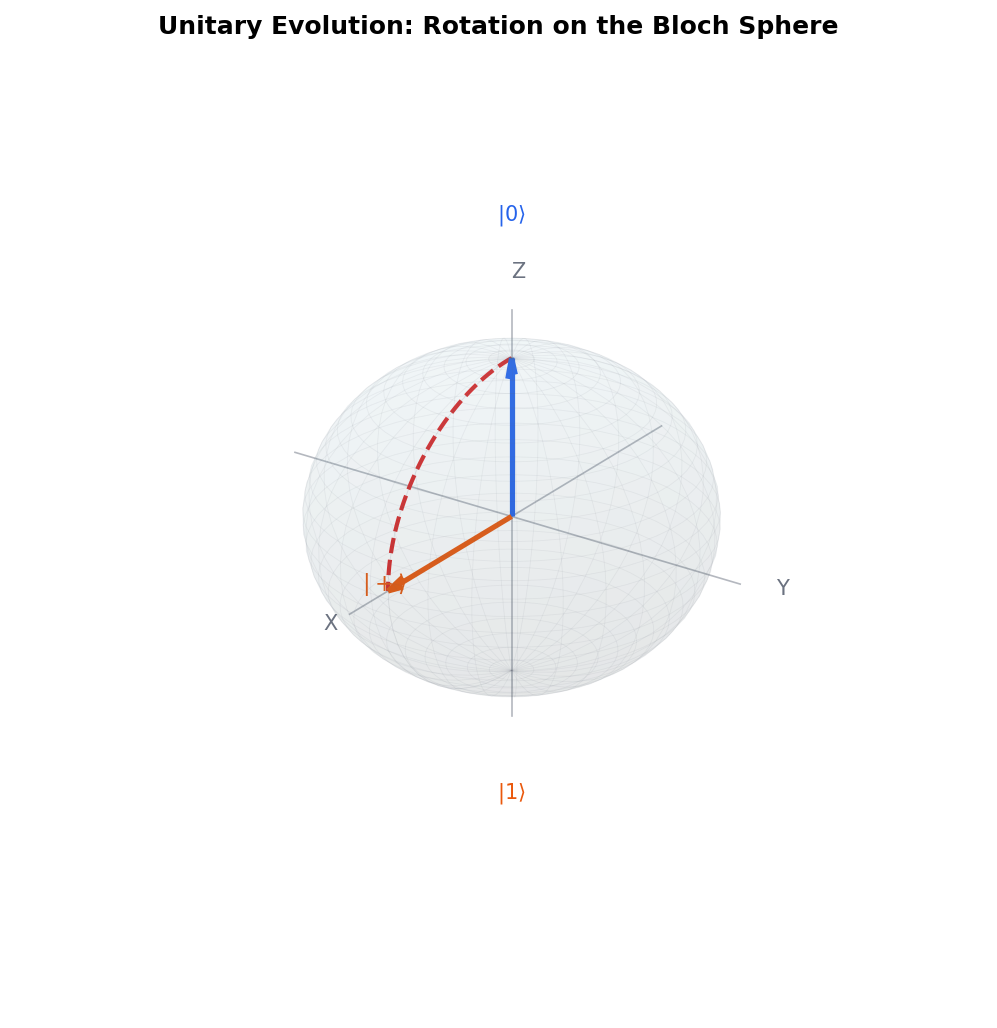
Technical Explanation
The continuous time evolution of a closed quantum system is governed by the time-dependent Schrödinger Equation:
$$i\hbar \frac{d}{dt}|\psi(t)\rangle = H(t)|\psi(t)\rangle$$
where $i$ is the imaginary unit, $\hbar$ (hbar) is the reduced Planck constant, and $H(t)$ is the Hamiltonian operator, a Hermitian matrix representing the total energy of the system.
If the Hamiltonian is constant over time, the solution to this differential equation yields the state at time $t$:
$$|\psi(t)\rangle = e^{-iHt/\hbar}|\psi(0)\rangle = U(t)|\psi(0)\rangle$$
where $U(t) = e^{-iHt/\hbar}$ is the time-evolution operator. This operator $U$ is a unitary matrix. A matrix $U$ is unitary if its conjugate transpose $U^\dagger$ (U-dagger) is also its inverse:
$$U^\dagger U = U U^\dagger = I$$
where $I$ is the identity matrix. This unitary property is a fundamental requirement of quantum mechanics because it preserves the inner product between any two states:
$$\langle\psi'|\phi'\rangle = \langle U\psi|U\phi\rangle = \langle\psi|U^\dagger U|\phi\rangle = \langle\psi|I|\phi\rangle = \langle\psi|\phi\rangle$$
Since the inner product is preserved, the norm of the state vector remains exactly 1 throughout the evolution ($|\langle\psi(t)|\psi(t)\rangle| = 1$). This ensures that total probability is conserved, and the state vector always remains on the surface of the Bloch Sphere.