Bloch Sphere Introduction
The Bloch sphere maps every pure single-qubit state to a unique point on a unit sphere, making states visual
Source: mortalapps.com- The Bloch Sphere is a 3D geometric representation of the state space of a single qubit.
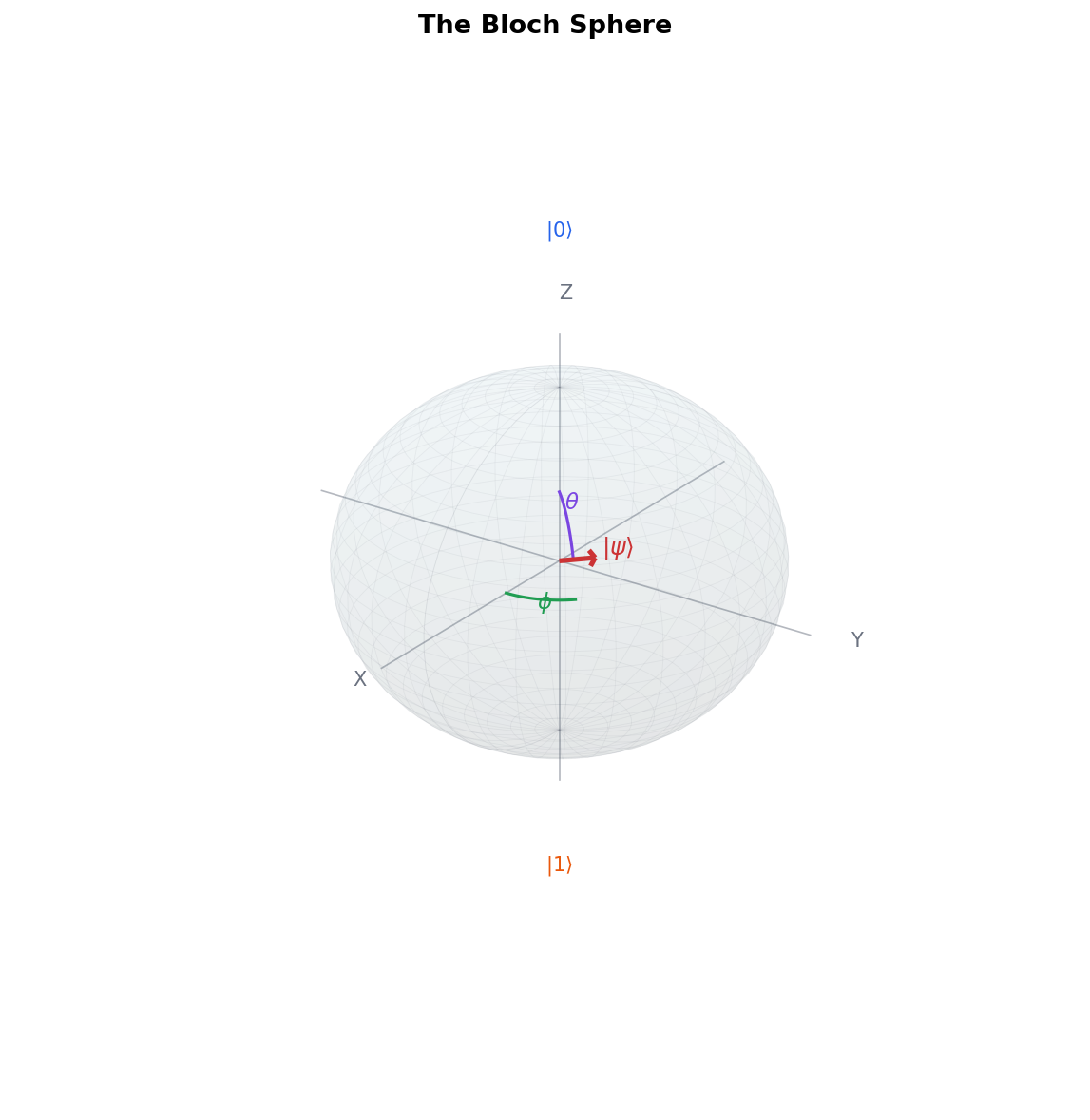
- Every point on the surface of the Bloch Sphere represents a unique, pure quantum state.
- The North Pole represents |0⟩, and the South Pole represents |1⟩.
- The equator of the sphere represents all equal superposition states, where the probability of measuring 0 or 1 is 50%.
- The polar angle θ determines the measurement probabilities, while the azimuthal angle φ determines the relative phase.
- Orthogonal states are located on opposite sides of the sphere (180 degrees apart).
Why This Matters
While linear algebra provides the mathematical rigor for quantum computing, humans are inherently visual creatures. Working entirely with complex column vectors can quickly become abstract and unintuitive. Fortunately, there is a brilliant geometric representation that maps the infinite state space of a single qubit onto the surface of a three-dimensional unit sphere. This sphere is called the Bloch Sphere, named after the physicist Felix Bloch.
In this topic, we will introduce the Bloch Sphere. We will explore how the complex coefficients of a qubit state are mapped to spherical coordinates (angles $\theta$ and $\phi$). We will locate the key states, such as the computational basis states and equal superpositions, on this sphere, and understand how physical operations correspond to simple rotations on its surface.
By the end of this topic, you will be able to visualize any single-qubit state as a point on the Bloch Sphere, translate between state vectors and spherical coordinates, and use this geometric intuition to predict how quantum gates will transform a qubit's state. This visualization tool is the single most important mental model in quantum information science.
Core Intuition
Imagine a standard globe of the Earth. Every location on the surface of the globe can be uniquely identified by two coordinates: latitude (how far north or south you are) and longitude (how far east or west you are). The Bloch Sphere is exactly like this globe, where every single point on the surface represents a unique, valid state of a qubit.
The North Pole of our globe represents the state $|0\rangle$, and the South Pole represents the state $|1\rangle$. If you are standing exactly at the North Pole, you are in a pure classical 0 state. If you are at the South Pole, you are in a pure classical 1 state.
The Equator of the globe represents all the equal superposition states, where the probability of measuring 0 or 1 is exactly 50/50. As you walk along the equator, you are not changing the *probabilities* of the states, but you are changing their *phase*. For example, the prime meridian intersection on the equator might represent the state $|+\rangle$, while the opposite side represents $|-\rangle$. Every point on this sphere is a physical reality for a qubit.
Visualization
Technical Explanation
To map a general qubit state $|\psi\rangle = \alpha|0\rangle + \beta|1\rangle$ to the Bloch Sphere, we parameterize the coefficients using two angles, $\theta$ (theta) and $\phi$ (phi). Because the global phase of a quantum state is physically unobservable (which we will prove in Topic 8), we can write any single-qubit state in the standard Bloch form:
$$|\psi\rangle = \cos\left(\frac{\theta}{2}\right)|0\rangle + e^{i\phi}\sin\left(\frac{\theta}{2}\right)|1\rangle$$
where:
- $\theta$ is the polar angle (colatitude), with $0 \le \theta \le \pi$. It determines the probability of measuring $|0\rangle$ or $|1\rangle$.
- $\phi$ is the azimuthal angle (longitude), with $0 \le \phi < 2\pi$. It determines the relative phase between the states.
We can map this state to a 3D Cartesian coordinate vector $\vec{r} = (x, y, z)$ on a unit sphere using the following transformations:
$$x = \sin\theta\cos\phi$$ $$y = \sin\theta\sin\phi$$ $$z = \cos\theta$$
Let us verify the poles. If $\theta = 0$, then $\cos(0) = 1$ and $\sin(0) = 0$. The state is $|\psi\rangle = 1|0\rangle + 0|1\rangle = |0\rangle$. This corresponds to the coordinates $(0, 0, 1)$, which is the North Pole. If $\theta = \pi$, then $\cos(\pi/2) = 0$ and $\sin(\pi/2) = 1$. The state is $|\psi\rangle = |1\rangle$, corresponding to $(0, 0, -1)$, the South Pole. The factor of $\theta/2$ in the state vector is crucial: it ensures that orthogonal states ($|0\rangle$ and $|1\rangle$) are mapped to opposite poles (separated by $\pi$ radians or 180 degrees on the sphere).